Good explanations.
Harder decisions.
Eight detailed hypothetical cases bring the pieces together. Follow the arithmetic, find the weak assumption and see what survives a less convenient outcome.
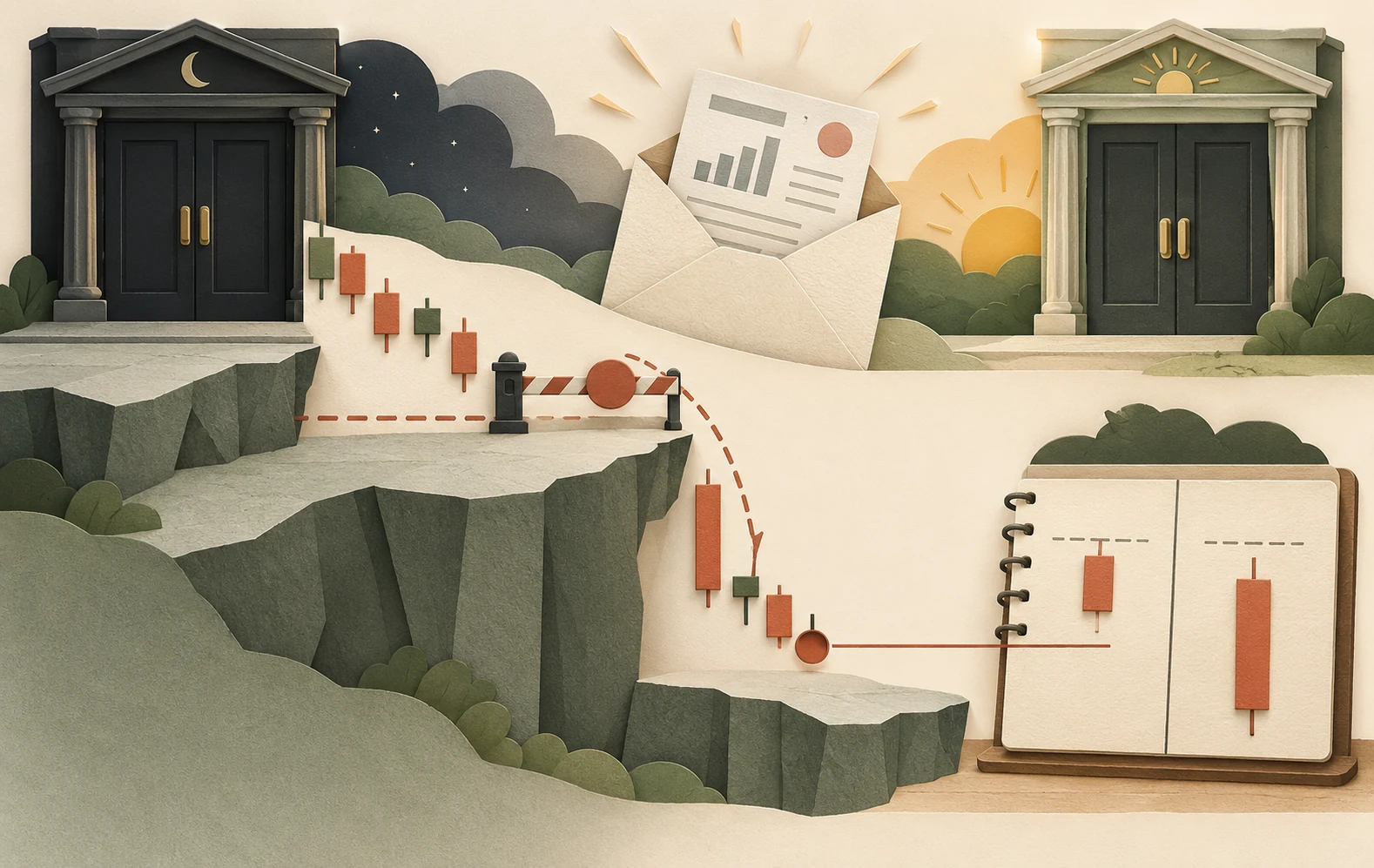
The stop that could not stop an earnings gap
A planned $250 loss becomes a $1,025 loss when the next executable price is nowhere near the trigger.
Work through the case ↗
The missing currency in a forex risk calculation
A yen-denominated loss must be converted into the account currency before a position can be sized.
Work through the case ↗
A correct thesis with the wrong funding clock
Short-sale arithmetic changes when price, borrow fees, and forced-close risk move against the trader together.
Work through the case ↗
One dollar on the screen is not one dollar in the bank
Separate token price, redemption access, and platform custody before treating a stablecoin balance as available cash.
Work through the case ↗
Fees earned, benchmark missed
A constant-product pool can rise in dollar value while underperforming the same tokens held outside the pool.
Work through the case ↗
Five positions, one underlying bet
Different tickers and asset classes can share the same vulnerability when liquidity disappears.
Work through the case ↗
The best backtest in the spreadsheet
Selecting the strongest of many experiments can manufacture confidence even when realistic execution erases the apparent edge.
Work through the case ↗
Profitable eventually, liquidated first
Variation losses and rising collateral requirements can exhaust available cash before a longer-term thesis is resolved.
Work through the case ↗Try it without
putting money at risk.
The workbook contains twelve shorter problems with worked answers. The journal gives you a place to record a thesis, an adverse scenario and what would change your mind.

How to work through a case
Use each case twice, for different questions. On the first pass, hide the worked result, list the inputs and reconstruct the account: positions, price changes, costs and the timing of cash needs. Put the unit beside every figure. Separate the calculation into three layers: the result of the price move, costs, and limits on execution or access to cash.
Compare the reasoning as well as the final number. A correct total reached by cancelling unrelated mistakes is not a reliable explanation. When your result differs, identify the first step at which the assumptions or arithmetic diverge. Correct arithmetic using the wrong currency, an unavailable exit price or an omitted obligation still leads to the wrong decision.
On the second pass, change one assumption, not the whole story: a later settlement date, a worse executable price or unavailable collateral. State which calculation must change, and keep the original answer beside the revised one. You can then separately test several linked adverse changes to see their combined effect.
Distinguish a conditional numerical result from a forecast and from an action you would be authorised and able to carry out. If information is missing, state exactly what needs to be established instead of substituting a convenient value.