A path through
the complexity.
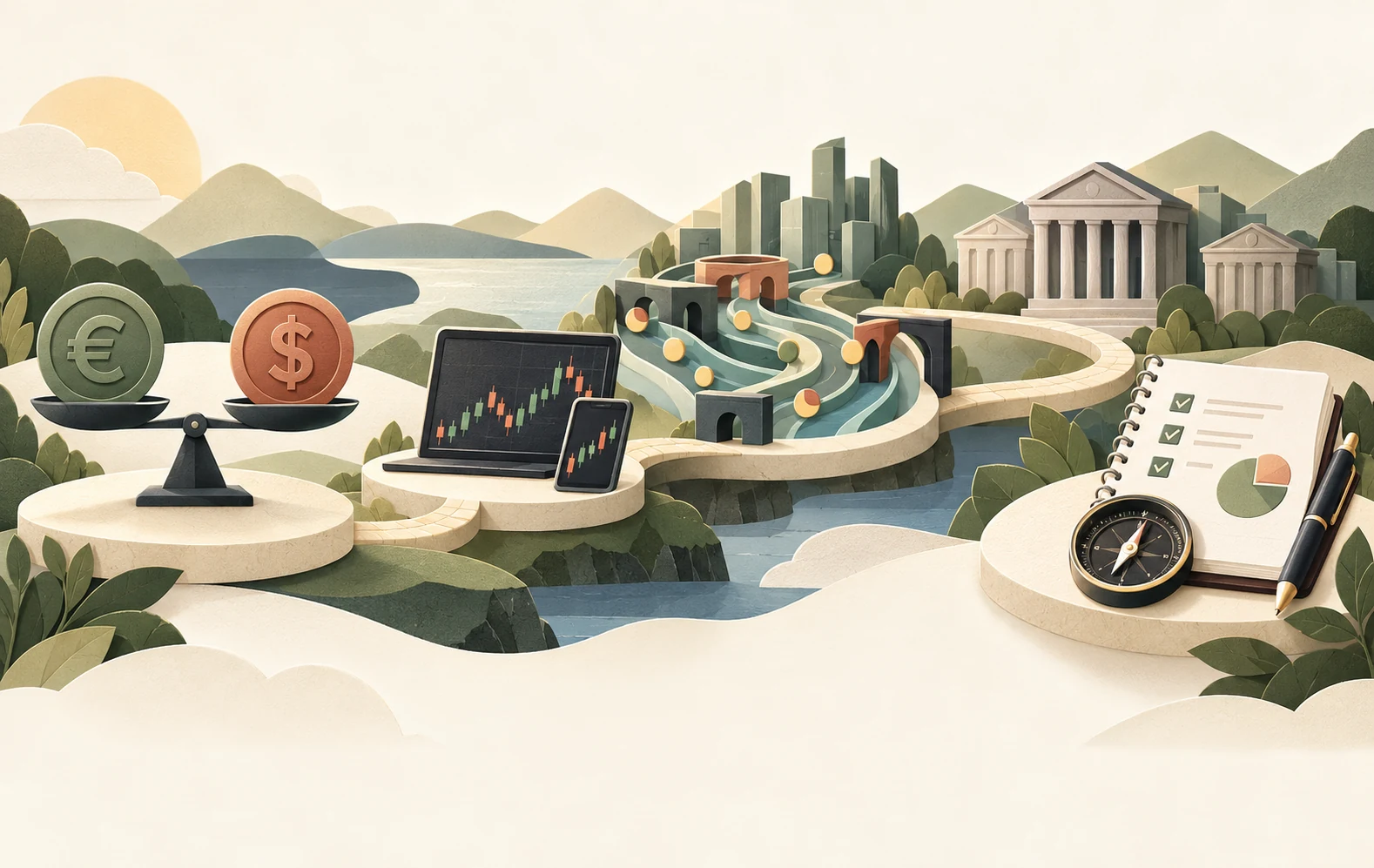
Each path has three stages: mechanics, connections and harder questions. Read at your pace, keep a short notebook and treat uncertainty as something to record rather than hide.

Forex
From a quoted pair to a complete FX thesis.
Follow the path ↗
Stocks
From owning a share to challenging a valuation.
Follow the path ↗
Crypto
From keys and custody to protocol-level risks.
Follow the path ↗
Risk & strategy
From a position size to an evidence-based process.
Follow the path ↗How to combine the paths
Start with a question you cannot yet answer without guessing: what do I own, how does a price move reach the account, or what evidence would weaken this idea? Choose the path that addresses that gap. Reading all four in parallel can make familiar terminology feel like understanding while leaving the underlying calculation unresolved.
Choose your main market according to what you want to understand. The forex path connects quotes with cash flows and financing; the stocks path connects shareholder rights with financial statements and business valuation; the crypto path connects control over an asset with the workings of protocols and intermediaries. The risk path helps you check calculations and research conclusions in all three areas.
Before changing stages, produce a small piece of work: a labelled cash-flow diagram, a calculation with units, or a comparison of two explicit scenarios. Close the lesson and explain why the answer changes when one assumption changes. Identify the assumption with the greatest effect on the answer and formulate a question for a primary source. If you cannot explain it or the concepts are unclear, return to the mechanism and the foundational lesson rather than collecting another completion mark.
Use the workbook to consolidate your practice, then move on to cases involving several interconnected risks. The aim is a usable explanation, not a faster route to a live trade. A learning path provides a sequence, but does not promise a particular time to mastery or readiness to trade.